

- /
The Top 7 Reasons People Are Moving to Southwest Florida in 2026
Southwest Florida is still more than a vacation spot. People keep relocating here from colder or higher-cost states, and the official population counts show why the questions “why move to Cape Coral” and “what is it like living in Southwest Florida” come up so often.
Lee County, which includes Cape Coral, Fort Myers, Estero, and Bonita Springs, was estimated at 874,890 residents as of April 1, 2026 — about 114,000 more than the 2020 Census count of 760,822. Cape Coral alone grew from 194,016 to 242,786 over that period, a gain of nearly 49,000 people, or about 25%. The U.S. Census Bureau’s July 1, 2025 estimate put the Cape Coral–Fort Myers metro at 875,607 residents, up about 15% from 2020. Collier County, home to Naples, was estimated at 415,341 in April 2026.
The reasons to move have not disappeared. What has changed is the fine print: insurance is still a real cost, the housing market is calmer than the peak years, and Florida voters just changed homestead tax rules in a way that matters if you are relocating in late 2026. Here are the top seven reasons people are moving to Southwest Florida in 2026, with those updates included.
1. Year-Round Warm Weather
The weather is still one of the biggest reasons people move here. It is not 70 and sunny every day, but it is a genuine break from long winters.
At Fort Myers Page Field, the official 1991–2020 climate normals show an annual average temperature of 75.4°F. January’s average high is 75.0°F, with an average low of 54.3°F. August’s average high is 91.7°F. Most of the rain falls in the wet season, from June through September; August averages 10.43 inches. Winter and spring are the drier months, which is when a lot of outdoor living actually happens — boating in January, a round of golf in February, or a beach sunset in March, while much of the Midwest and Northeast is still in winter.
If you are relocating from up north, plan for hot, humid summers and a real rainy season. The trade-off is a winter that still feels like the outdoors.
2. No State Income Tax — and, for Many Buyers, More House for the Money
Southwest Florida is not the cheapest place in the country, and it is not accurate to talk only about “low cost of living” without mentioning insurance. Two cost facts still work in this region’s favor.
Florida does not impose a personal income tax, or an inheritance or gift tax. That is a straight savings for people who have been paying a state income tax in places such as New York, New Jersey, or California.
On housing, Lee County is still less expensive than much of coastal Florida. In October 2026, the median sale price for a single-family home in the Cape Coral–Fort Myers metro (Lee County) was $389,900, unchanged from October 2025, according to Florida Realtors. The statewide single-family median was $420,000. In neighboring Collier County (the Naples–Marco Island metro), the single-family median was $780,000. Lee County condos and townhouses closed at a $269,000 median in October, down 3.9% from a year earlier. Someone who sells a home in a high-priced coastal market may still be able to buy more home here, sometimes closer to the water — but that depends on the sale, the mortgage rate, and the insurance quote, not on a rule of thumb.
Property insurance remains part of the budget. The good news is that Florida’s residual market has been shrinking and some Citizens rates went down in 2026. Citizens Property Insurance said its homeowners multiperil rates fell by an average of 8.8% for policies effective July 1, 2026, and that its policy count had dropped to about 336,000 from a peak of 1.41 million in October 2023. Quotes still vary by roof, construction, and flood zone, so get numbers before you write an offer. I have a Southwest Florida flood zone map you can use to start that conversation.
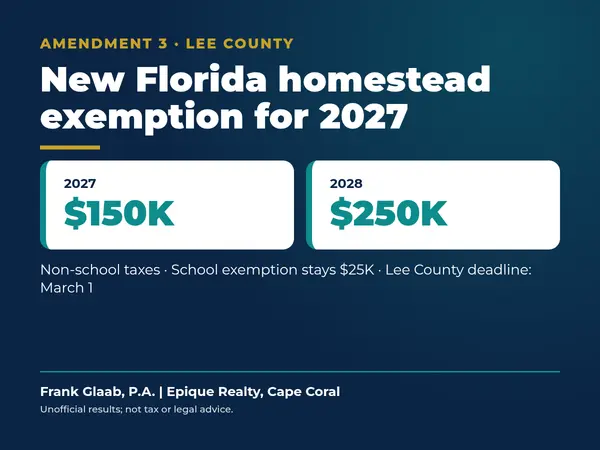
There is also a 2026-specific tax deadline. On November 3, 2026, Florida voters approved Amendment 3, which raises the homestead exemption for non-school property taxes to as much as $150,000 in 2027 and $250,000 in 2028. School-tax exemptions stay at $25,000. The catch: people who are not Florida residents as of December 31, 2026, start at a smaller exemption and generally wait until the fifth year of homestead for the higher amount. If you are relocating this year and the deadline matters to you, read my guides on becoming a Florida resident before the Amendment 3 deadline and how Amendment 3 affects Cape Coral homestead taxes, then confirm the details with the county property appraiser.
3. Waterfront Living and a Boating Lifestyle
Cape Coral is built around water. The city says it has more than 400 miles of freshwater and saltwater canals, many with access to the Caloosahatchee River and the Gulf. That is a big reason people ask why they should move to Cape Coral instead of another coastal market: a private dock and a boat lift are more common here than in most U.S. cities.
Not every canal is the same, and not every “Gulf access” route is a straight run with no bridges. Some homes are on freshwater canals. Some have access that passes under fixed bridges, which limits taller boats. Others have sailboat or more open Gulf access. If boating is part of the move, check the actual run time and bridge clearances for the address, not just the listing headline. My boat time to the Gulf tool and Gulf access homes in Cape Coral page are built for that.
Fort Myers, the riverfront, and parts of southern Lee County — including Estero and Bonita Springs — offer a different mix of waterfront condos, gulf-access communities, and homes a short drive from the beaches. The lifestyle is the draw. The homework is making sure the water in front of the house matches how you actually boat.
4. A Diversified Local Economy — and the Option to Work Remotely
Southwest Florida is not only a place people move after they leave the workforce. The Cape Coral–Fort Myers economy keeps adding jobs, just not at a “boom” pace.
The U.S. Bureau of Labor Statistics reported 317,800 nonfarm jobs in the metro in October 2026, up 1.6% from a year earlier (preliminary). Education and health services employed 56,400 people, up 2.7%. Professional and business services employed 46,500, up 4.3%. Leisure and hospitality, which covers much of the tourism economy, employed 41,500, up 2.0%. Construction held about steady at 40,900 jobs. The unemployment rate was 4.8% in September 2026 (preliminary).
Remote work still lets some people bring a job with them. For everyone else, healthcare, professional services, hospitality, and trade are the local pillars. If a job is part of your move, look at current openings and commute patterns rather than older “fastest-growing” headlines.
5. Parks, Recreation, and Everyday Amenities
One practical reason people stay, once they have moved, is how much of daily life can happen outdoors.
Cape Coral’s parks system includes places such as Rotary Park & Environmental Center, Four-Mile Cove Ecological Preserve, and Sirenia Vista Park, along with boat ramps, trails, sports complexes, and water-based recreation. Estero, Bonita Springs, and Fort Myers have their own networks of parks, preserves, and public golf and recreation facilities. Southern Lee County is close to both inland amenities and the beaches.
That is a feature of the place, not a promise about any one neighborhood. When you are shopping, walk the parks, the boat ramps, and the streets at the time of day you would actually live there, and decide what fits your routine.
6. Beaches, Preserves, and Year-Round Outdoor Time
If you want water and wildlife in the same week, this region is hard to match. Sanibel, Captiva, Fort Myers Beach, and the Naples beaches are the well-known stretches of sand. Inland, there are mangrove trails, wildlife refuges, and kayak routes, including access to the Great Calusa Blueway. Golf is a year-round option, not a five-month season.
Living in Southwest Florida means those places are a day trip or less, not an annual vacation. The same geography that makes the boating good — the river, the barrier islands, the preserves — is what you use on a free afternoon.
7. A Longtime Place to Retire — With a More Honest Cost Picture
Florida has been a popular place to retire for decades, and Southwest Florida is a large part of that story. The climate, the lack of a state income tax, and the presence of a sizable healthcare sector are the usual reasons, and they still apply in 2026.
What I would not do is call the region “cheap” across the board. Lee County’s October 2026 single-family median of $389,900 is well below Collier County’s $780,000, so many buyers do find more home in Cape Coral or Fort Myers than in Naples. Insurance, flood zone, and, if you want the higher Amendment 3 homestead exemption, the December 31, 2026 residency date all belong in the same conversation as the list price. Healthcare access here is a real local industry — education and health services is one of the metro’s largest employment sectors — but the right doctor or campus still depends on your needs, not on a slogan.
If retirement is the reason you are moving, the same neighborhoods and waterfront questions apply as they do for everyone else: where the house sits, what the insurance costs, and how you want to spend the year.
Frequently asked questions
Why move to Cape Coral in 2026?
Cape Coral offers a rare combination: a large canal system, a still-growing city, and single-family prices that, at the October 2026 median of $389,900, sit below both the Florida statewide median and Naples-area prices. The reasons people move — weather, no state income tax, and boating — are still in place. The 2026 homework is insurance, flood zone, and, if homestead savings matter, the Amendment 3 residency date.
Is the cost of living lower than in other coastal states?
It can be, especially if you are leaving a high-tax or high-price coastal market, because Florida has no state personal income tax and Lee County home prices are lower than many coastal peers. It is not automatically cheaper once you add homeowners and flood insurance. Get those quotes before you compare monthly payments.
What should I know about insurance and flood zones before I relocate?
Budget for wind and, on many properties, flood coverage. Citizens’ average 2026 homeowners multiperil rate went down, and more private options have returned, but every house is different. Check the flood zone, the roof, and a real insurance quote early. Start with my flood zone map.
Does Amendment 3 change anything if I move this year?
Yes, if you plan to homestead a Florida home. Voters approved the amendment on November 3, 2026. The higher non-school homestead exemption phases in for 2027 and 2028, but people who are not Florida residents as of December 31, 2026, generally wait until the fifth year of homestead for the full increase. I walk through the residency steps in this Amendment 3 guide. Confirm your situation with the property appraiser.
Bottom line
If you are moving to Southwest Florida in 2026, or relocating to Cape Coral, Fort Myers, or southern Lee County, the core reasons still hold: warm winters, no state income tax, waterfront living that is hard to copy, and plenty to do outside. The honest 2026 version also includes a calmer housing market, insurance you should price up front, and a homestead deadline that is only a few weeks away for anyone trying to qualify this year.
If you want help narrowing neighborhoods, checking boat access, or walking through how a house would actually cash-flow after taxes and insurance, contact me. I work with buyers and sellers throughout Cape Coral and the rest of Southwest Florida.
Frank Glaab, P.A.
Broker Associate, Epique Realty
(239) 243-6224
frank@movecapecoral.com
movecapecoral.com
Frank Glaab, P.A., Epique Realty
Sources
- University of Florida Bureau of Economic and Business Research (BEBR) / Florida Office of Economic and Demographic Research, Florida Population Estimates by County and Municipality, April 1, 2026. Lee County 874,890 (2020 Census 760,822; change +114,068); Cape Coral 242,786 (2020: 194,016; change +48,770); Fort Myers 104,891; Estero 38,174; Bonita Springs 56,577; Collier County 415,341 (2020: 375,752). https://www.edr.state.fl.us/Content/population-demographics/data/2026_Pop_Estimates.pdf
- U.S. Census Bureau, Vintage 2025 metro population estimates, July 1, 2025, Cape Coral–Fort Myers, FL MSA: 875,607 (FRED series FTMPOP, source: U.S. Census Bureau; updated March 27, 2026; retrieved November 20, 2026). 2020 Census figure used for the percent change: 760,827. https://fred.stlouisfed.org/series/FTMPOP and https://www.census.gov/data/datasets/time-series/demo/popest/2020s-total-metro-and-micro-statistical-areas.html
- National Weather Service, Tampa Bay area, Fort Myers monthly/annual normals (1991–2020) and records. Annual average 75.4°F; January average high/low 75.0 / 54.3; August average high 91.7; August precipitation 10.43 inches; annual precipitation 57.41 inches. Also published by the Florida Climate Center (Fort Myers Page Field, COOP 083186). https://www.weather.gov/media/tbw/climate/fmyannnormrec.pdf and https://climatecenter.fsu.edu/products-services/data/1991-2020-normals/ft-myers
- Florida Department of Revenue, Tax Information for New Residents (GT-800025, R. 08/25): “Florida does not impose personal income tax, inheritance tax, gift taxes, or tax on intangible personal property.” https://floridarevenue.com/forms_library/current/brochure/gt800025.pdf
- Florida Realtors, Florida Residential Market Sales Activity — October 2026 MSA summary, released November 16, 2026. Cape Coral–Fort Myers (Lee County) single-family: 1,115 closed sales (−0.7%), median $389,900 (0.0%); year-to-date median $385,000 (0.0%). Naples–Immokalee–Marco Island (Collier County) single-family median $780,000 (+4.9%). Statewide single-family median $420,000 (+2.2%), 19,049 sales (−10.1%). Lee County condo/townhouse median $269,000 (−3.9%), 373 sales (+12.7%). https://www.floridarealtors.org/sites/default/files/2026-11/October-2026-Fla-MSA-summary.pdf and https://www.floridarealtors.org/news-media/news-articles/2026/11/florida-home-sales-slow-october-mortgage-rates-rise
- Citizens Property Insurance Corporation, July 2026 rate updates (effective July 1, 2026): average 8.8% decrease for homeowners multiperil policies. Citizens’ March 4, 2026 rate kit: policy count about 336,000, down from a peak of 1.41 million in October 2023; at least a 2% reduction for all personal-lines policyholders. https://www.citizensfla.com/-/20260430-july-2026-rate-rule-and-wind-loss-mitigation-updates and https://www.citizensfla.com/documents/20702/39683240/Revised+2026+Rate+Kit.pdf/a4a0d261-807d-eb09-50fa-c1e0759ef9b5
- Florida Division of Elections, Florida Election Watch, Amendment 3 results: Yes 4,922,977 (61.98%), No 3,020,085 (38.02%); 60% required to pass. https://floridaelectionwatch.gov/Amendments
- Florida Department of Revenue, Property Tax Oversight Informational Bulletin PTO 26-21, November 5, 2026. Amendment 3 approved November 3, 2026; non-school homestead exemption up to $150,000 in 2027 and $250,000 in 2028; people who are not Florida residents as of December 31, 2026, receive a smaller exemption at first, with the increased exemption beginning in the fifth year; effective January 1, 2027, first applies to the 2027 tax roll. https://floridarevenue.com/property/Documents/PTO_BUL_26-21.pdf
- U.S. Bureau of Labor Statistics, Cape Coral-Fort Myers, FL Economy at a Glance, data extracted November 20, 2026. October 2026 preliminary nonfarm employment 317,800 (+1.6% year over year); education and health services 56,400 (+2.7%); professional and business services 46,500 (+4.3%); leisure and hospitality 41,500 (+2.0%); construction 40,900 (0.0%); September 2026 preliminary unemployment rate 4.8%. https://www.bls.gov/eag/eag.fl_capecoral_msa.htm
- City of Cape Coral, Boating, and Why Cape Coral / Lifestyle pages: “more than 400 miles of canals,” many with access to the Caloosahatchee River and the Gulf; parks mentioned above (Rotary Park, Four-Mile Cove Ecological Preserve, Sirenia Vista Park); Great Calusa Blueway kayak access. https://www.capecoral.gov/departments/parks_recreation/outdoor_recreation/boating.php and https://www.capecoral.gov/departments/office_of_economic_business_development/why_cape_coral/lifestyle.php
Categories
Recent Posts



Epique Realty
Phone